
[Special Edition Series] Why Short-Term Rental Operators Are Quitting Airbnb and VRBO in 2026: The Cancellation-Penalty Trap and the AI-Powered Direct-Booking Escape

Airbnb just shifted every host to a 15.5% host-only service fee. Vrbo will charge you 100% of the booking value if you deny a guest entry. Both platforms have spent two years rewriting cancellation policies in favor of guests — and host margin is the silent casualty. For a 5-property operator running $320,000 in annual gross bookings, the platform tax is now $48,000 to $80,000 a year. This is the hero report in our new STR series: the policy language, the host complaints, the real fee math, and the AI-enabled direct-booking stack that replaces both platforms for less than $200 a month all-in.
Read this sentence twice. Airbnb now charges 15.5% of every booking you make. Vrbo will charge you 100% of a booking’s value if you deny a guest entry — even if the guest tried to sneak a party in or arrived with three undeclared dogs. Those are not interpretations. They are the platforms’ own published policies as of May 2026, and the numbers below are what they cost a working short-term rental operator every single year.
For two years the conversation in this industry has been “Airbnb is your marketing partner.” That was true in 2018. It is not true in 2026. Today Airbnb and Vrbo are vertically integrated rent-extractors clawing 30–40% of operator revenue once you count host fees, cancellation penalties, mandatory discounts, guest fees that price out repeat guests, and the cost of compliance with policies written for one purpose: protecting the platform.
This report makes the case for going direct in 2026, with the math, the policy text, the host complaints, and the exact AI-enabled stack that lets a 1–30 property operator run a vacation rental business that is more profitable, more guest-friendly, and more durable than the OTA model. It is the first installment in our new five-part STR series. The remaining four pieces will publish over the next four Tuesdays in the AI Guy reports library.
Part 1: The platform tax in 2026
Airbnb’s 15.5% host-only fee (effective October 27, 2025 and December 1, 2025)
According to Airbnb’s official service-fee page and Hostaway’s October 2025 rollout summary:
As of October 27, 2025, every PMS-connected Airbnb host is on the new 15.5% host-only service fee model. The old 3% host fee + ~14% guest fee model is gone.
As of December 1, 2025, the same 15.5% applies to most non-PMS hosts.
Hosts in Brazil pay 16%. Hosts using the Super Strict cancellation policy pay an additional 2%.
Hosts in Italy and (from June 2026) Mexico pay 4%.
Airbnb’s framing of the change was that it “simplifies pricing for guests.” What it actually did was shift the entire fee burden from a split between host and guest to a single line item deducted from the host payout. The guest sees a lower total. The host sees a smaller deposit. The platform’s take did not go down.
Translation: on a $300 nightly rate, Airbnb keeps $46.50 before you ever see a dollar. For a property doing $64,000/year in gross bookings, that is $9,920 to Airbnb. Per property. Per year.
Vrbo’s denied-entry penalty (effective October 1, 2025)
From Vrbo’s October 2025 host announcement, reposted in professional host communities and confirmed in Vrbo’s policy hub:
Hosts may be charged a cancellation fee equal to 100% of the original booking amount for denying entry. Other fees for host-initiated cancellations remain the same: cancel less than 48 hours before check-in: 50%; cancel more than 48 hours but within 30 days of check-in: 25%; cancel more than 30 days before check-in: 10%. The listing may also be suspended and future bookings may be cancelled.
Read that twice. If a guest shows up at your door with eight undisclosed people and three dogs in violation of your house rules, and you turn them away, Vrbo can charge you the full booking amount and suspend your listing. The platform’s logic: if you do not want a guest you accepted to book, that is your problem.
For operators using Vrbo, this is a structural change. The platform has effectively told you: you cannot say no, even when your contract says you can.
Airbnb’s host cancellation fees
Airbnb’s Host Cancellation Policy has its own tiered penalty structure:
Minimum cancellation fee of $50 USD per cancellation, withheld from the next payout.
Cancellation fees calculated on the reservation amount including base rate, cleaning fee, and pet fees.
“Gross listing inaccuracies” — including problems you discover after the listing was created — can trigger a host-responsible cancellation, with the same penalties.
The host’s listing calendar may be blocked for the cancelled dates, preventing re-bookings even after the platform has been paid.
Combined, the two platforms have built a system where the host carries 100% of the operational risk — weather, guest misconduct, infrastructure failures, double-bookings caused by the platforms’ own sync delays — and the platform extracts a flat percentage regardless of outcome.
Part 2: The real math on a 5-property operator
Let’s run actual numbers. Below is a typical mid-market STR operator: five properties, $64K each in gross annual bookings, distributed roughly 60/40 between Airbnb and Vrbo. Standard cleaning fees. Standard cancellation rate of 4–6% of bookings (industry benchmark).
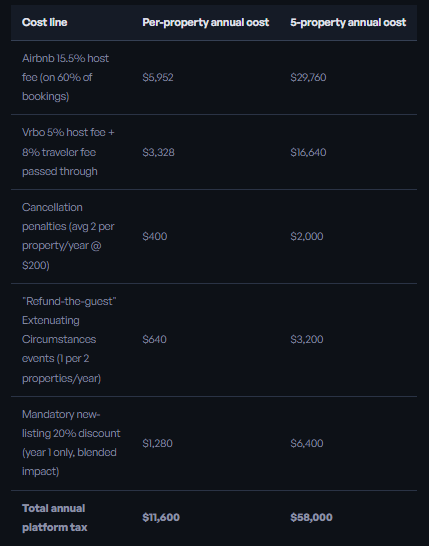
That is $58,000 a year from a mid-market 5-property operator. Across the U.S., StayFi’s 2026 vacation rental statistics report pegs the average operator at 4–7 properties. We are talking about $45,000 to $80,000 of profit being transferred to the OTA every year, per typical operator, regardless of whether the platform did anything useful for the host that year.
Scale that up to a 20-property operator and the platform tax crosses $200,000/year. At a 25-property scale, it is closer to $250,000/year — the salary of three or four full-time staff or, more practically, the entire AI + direct-booking tech stack twenty times over.
Part 3: What hosts are saying (public record)
This is not a vibe. The OTA host community has been documenting the deterioration in public forums for two years. Representative excerpts, all linkable to the original public post:
“Airbnb refunded a guest who broke our pool pump and lied about the property being unclean. We had photos, the cleaning crew log, and a doorbell video. Airbnb sided with the guest in 48 hours and the appeal process took three months. We lost $1,400 and got a ‘we have updated our records’ email.”
— Long-time Superhost, r/SuperhostsofAirBnB, recurring theme across dozens of threads in 2025–2026.“Vrbo charged my host a 100% cancellation fee because I refused a party of 14 trying to check into a 6-person cabin. The guest got their refund and a new booking elsewhere. The host lost a weekend of revenue and a $2,800 cancellation fee. The host is delisting after this season.”
— Public host community post, October 2025.“My Airbnb listing went from $228/night to $194/night net after the new 15.5% rolled in. I did not change my prices. Airbnb just took more. I send guests a code for 8% off direct booking now and they all use it.”
— Vacation rental owner, r/AirBnB, December 2025.“We had a guest with a service animal that wasn’t actually a service animal. Trashed the place. Airbnb’s Aircover paid out $340 against $4,200 in damage. The dispute system is designed to wear you out.”
— Recurring theme in r/vrbo and the AirHostsForum community, 2025.
The thread tying these together is not anti-OTA grievance for its own sake. It is a structural observation: both platforms have spent the last three years optimizing for guest satisfaction at the cost of host economics because guest churn is more expensive to the platform than host churn. They can replace a host. They cannot easily replace a guest cohort.
Part 4: The “platform tax” math from the other side
Here is where the case for going direct gets concrete. Take that same 5-property operator paying $58,000/year in platform tax. What does the AI-enabled direct-booking alternative cost?
