
AI Route Optimization + Dispatch for SMB Logistics (2026): Vendor Pricing, ROI Models, and a 30-Day Rollout Plan

For small fleets, the last mile is now the most expensive mile — and the one most quickly reshaped by AI. This report breaks down what to automate first, what vendors actually charge in 2026, how to model ROI from miles, labor, and failed-delivery reductions, and how to roll out a working dispatch stack in 30 days without breaking your operation.
Executive summary
The last mile is now ~53% of total shipping cost for most parcel-style operations — meaning routing and dispatch decisions are where SMB margin actually lives or dies, not in linehaul ([eMarketer 2026 last-mile FAQ](https://www.emarketer.com/content/faq-on-last-mile-delivery--how-final-step-of-fulfillment-will-take-shape-2026)).
Routing AI is a profit lever, not a science project. The mature reference point is UPS ORION — described publicly as 100 million miles avoided, 10 million gallons of fuel saved, and $300–$400M in annual savings at full deployment ([INFORMS ORMS Today](https://pubsonline.informs.org/do/10.1287/orms.2016.03.10/full/)). Even at SMB scale, the same three levers — miles, labor, exceptions — drive the math.
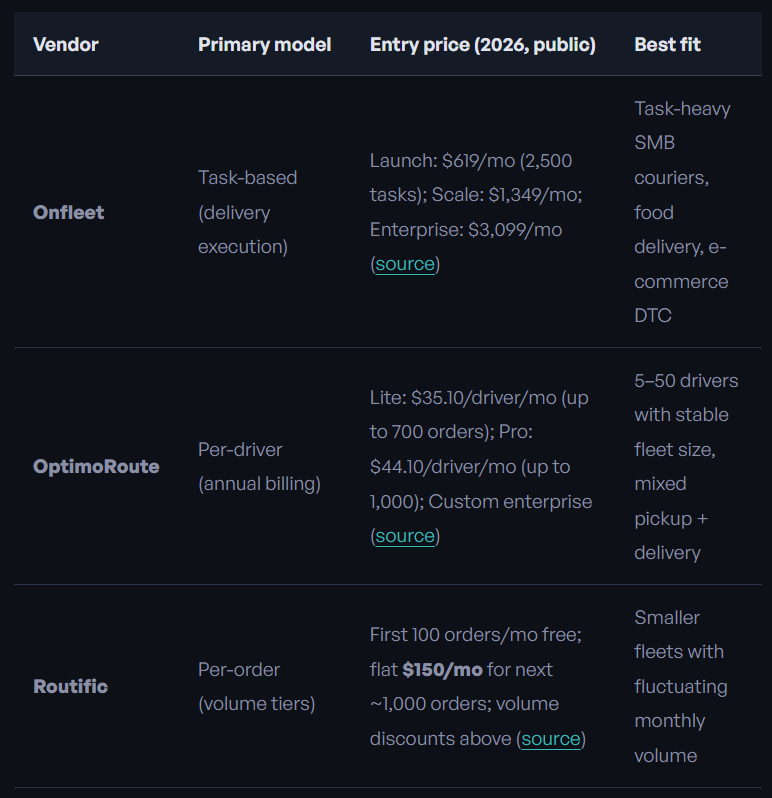
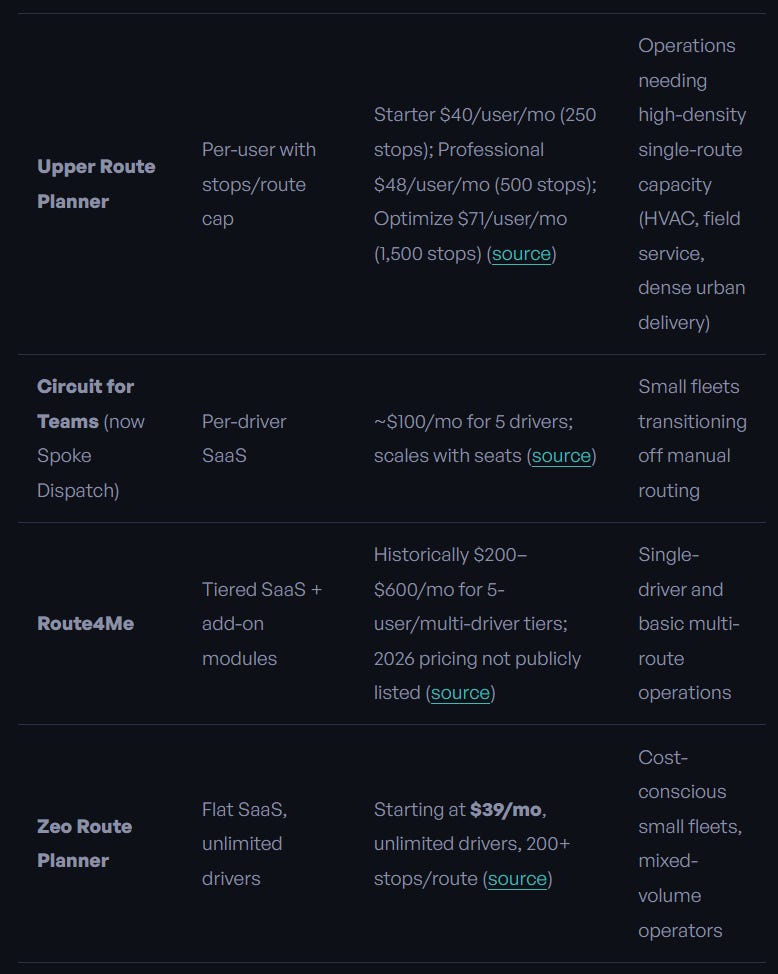
2026 SMB pricing is finally transparent. A working dispatch stack for a 5–15 truck operation now runs roughly $150–$1,500/month, depending on whether you optimize for tasks, drivers, or stops ([Onfleet pricing](https://onfleet.com/pricing), [Upper pricing](https://www.upperinc.com/pricing/), [OptimoRoute pricing breakdown via Checkthat](https://checkthat.ai/brands/optimoroute/pricing)).
Most failed rollouts are data + change-management failures, not algorithm failures. The teams that win standardize service times, stop constraints, and exception playbooks first — then turn on optimization. We give you the exact 30-day path below.
ROI test for SMBs: if route optimization software can save you one dispatcher day per month or eliminate 3–5 failed deliveries per week, it pays for itself at list price. Most well-run pilots clear that bar in the first 30 days.
Why SMB last-mile economics changed in 2026
Three structural shifts converged in the last 18 months and pushed AI routing from “nice to have” to “table stakes” for small fleets:
1) Cost concentration in the last mile
Across e-commerce and direct-to-consumer fulfillment, the last mile has grown to roughly 53% of total shipping cost ([eMarketer 2026](https://www.emarketer.com/content/faq-on-last-mile-delivery--how-final-step-of-fulfillment-will-take-shape-2026)). For SMB operators — local couriers, regional 3PLs, food & beverage distributors, HVAC parts runners, florists, building-supply yards — that ratio is often even higher because there is no consolidated middle mile to dilute it. Every inefficient stop sequence, every reattempted delivery, every dispatcher minute spent rerouting on the fly comes out of operating margin.
2) Driver labor remains the single largest line item
Whether you measure loaded hourly cost (wage + benefits + workers’ comp + truck overhead) or take total fleet labor as a percent of revenue, drivers are the dominant cost. That makes “minutes saved per route” — not just “miles saved” — the most valuable optimization target. A 6–10% reduction in on-road time across a 10-truck fleet can be worth more than a year of software cost in a single quarter.
3) Customer expectations are now Amazon-shaped
SMB shippers don’t have to match Amazon’s same-day promise, but they do have to give customers reliable ETAs, proactive exception notifications, and proof of delivery. The dispatch stack that handles this well sees lower inbound call volume, fewer chargebacks, and higher reorder rates — which is, in practice, a marketing lever disguised as an operations tool.
The teams who treat 2026 as the year to finally automate dispatch will compound a margin advantage that becomes hard to dislodge: better routes → better driver retention → better customer reviews → better repeat business → lower CAC.
What SMB logistics teams should automate first (and why)
The typical small-to-mid logistics operator has the same hidden cost structure: routing decisions are made in a hurry the night before (or the morning of), exceptions get handled by whoever is closest to the phone, and the organization learns about problems after the day is already lost. The goal of an AI-enabled dispatch stack is to shift decisions earlier (plan), faster (execute), and cheaper (reduce rework).
1) Route planning with real constraints
Inputs that matter: stop location, promised time windows, realistic service-time estimates, capacity (weight/volume), driver shift limits, vehicle constraints (lift gate, refrigeration, vehicle class), and special handling (signature, ID checks, gated access).
Automation objective: produce an executable route sequence that is feasible for humans and respects operational constraints — not just “shortest distance on a map.” Drivers will sabotage routes that ignore real-world friction (no left turns at a specific intersection, a customer who only takes deliveries after 10am, a dock that is single-truck at peak hour). Good optimization tools let you encode these as soft and hard constraints.
The “service time” landmine: the single biggest source of bad routes is service-time defaults that don’t match reality. A florist drop is 90 seconds; an HVAC parts delivery into a chained yard is 12 minutes. If your service-time per stop type is wrong, the optimizer will hand you routes that look great on paper and collapse by 2pm.
2) Dispatch automation (assignment + release + exception routing)
Assignment: match stops to drivers/vehicles based on geography, capacity, shift rules, and skill (CDL, hazmat, equipment certifications). For SMB operators, this is where 60–80% of the dispatcher’s day goes — and it’s nearly fully automatable.
Release: push routes to driver mobile devices with turn-by-turn navigation, route checklists, and structured proof-of-delivery steps. The mobile UX matters as much as the algorithm: drivers will work around any tool that requires more than two taps per stop.
Exception routing: automatically re-optimize when a truck goes down, a priority stop appears, traffic creates a miss, or a customer reschedules. The most overlooked feature in SMB tooling is “what happens at 1pm when reality has already diverged from the morning plan?” — the dispatch system needs an answer.
3) Customer communications + proof of delivery
These are the cheapest “quick wins” because they reduce inbound calls and resolve disputes faster. Many operators dramatically under-estimate the value of simply making delivery status reliable. Specifically:
Pre-route ETA: text the customer the night before with the planned window. Lowers no-one-home failures.
Out-for-delivery + dynamic ETA: ETA updates as the route progresses. Reduces inbound “where is my driver” calls.
Proof of delivery with photo + GPS-stamped signature: ends chargeback disputes in your favor and shrinks reverse logistics work.
Exception alerts with self-service rescheduling: shifts work off the dispatcher onto the customer, where it belongs.
4) KPI reporting + driver scorecards
Once the operational layer is automated, the data exhaust is the next lever. Per-driver scorecards (stops/hour, on-time %, exceptions, photo POD compliance) drive behavior change without confrontation. Per-zone profitability views surface the customers and geographies you should fire — or charge more to keep.
Vendor pricing: what it actually costs in 2026
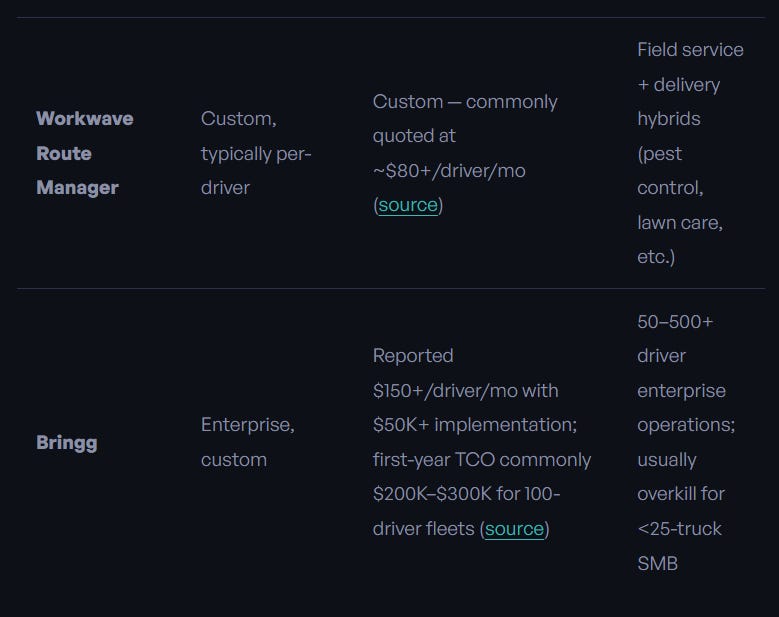
For SMB buyers, the key is to separate route optimization (the math) from delivery execution (the workflow). In many stacks, you’ll buy both — but knowing the unit economics (per user, per driver, per task, per stop) is what keeps the rollout from becoming a surprise monthly bill at the 90-day mark.
The table below summarizes the most commonly evaluated SMB platforms with 2026 list pricing where it is publicly disclosed. Always confirm with the vendor — pricing pages move, and most platforms negotiate at the annual contract level.
How to read the pricing matrix
Task-based (Onfleet, Zeo, Routific): your cost rises with order volume, not headcount. Good when fleet size is volatile but order volume is steady-ish.
Per-driver (OptimoRoute, Circuit, Workwave, Bringg): your cost is predictable but punishes seasonal hiring spikes. Good for stable fleets, painful in peak season unless you negotiate flex seats.
Per-user with stops/route cap (Upper): your cost depends on per-route density. Good for high-density urban routes; less efficient if your routes are spread thin.
Hybrid execution + optimization stacks: many SMBs end up running two tools — one for the math (Routific, OptimoRoute, Upper) and one for the driver execution + customer comms (Onfleet, Circuit). Budget for both, but pick a primary system of record.
Practical guidance: if your operation is “task heavy” (many small drops, fluctuating fleet), your primary cost driver is the execution layer — start with Onfleet or Routific. If your operation is “constraint heavy” (time windows, multi-depot, capacity, vehicle skills), your primary driver is route optimization — start with OptimoRoute or Upper. If you are sub-10 drivers and price-sensitive, Zeo and Circuit for Teams are the most defensible entry points.
Continue reading FREE on ai.advalorem.io, includes:
30-day rollout plan (SMB-friendly, tested in the field)
Implementation patterns and anti-patterns
Integration patterns: where the dispatch stack plugs in
KPIs to watch (and what good looks like for SMB)
A buying checklist (what to demand in vendor demos)
Common pitfalls (and how to avoid them)
Where this goes next (12–24 months)
If you take only three things from this report
If you take only three things from this report
The last mile is now ~53% of total shipping cost. Treat routing and dispatch as a margin lever, not an IT project.
The math is solved. The win is in data + change management. Spend week 1 on service times and constraints, not vendor selection.
A 30-day pilot with conservative ROI assumptions will tell you what you need to know. Don’t let the perfect business case kill the good pilot.
If you want, we can turn this into a vendor short-list and a one-page ROI model for your specific fleet size, service area, and stop profile — and have it back to you tomorrow.
Need this implemented?
Get a decision-grade memo on this — by tomorrow.
Send a brief by 5pm. Get a board-ready memo in 24 hours. Powered by Council Mode — 20+ AI models cross-checked on every recommendation.
Standard Sprint — $1,750 / 24hr
Same-Day Rush — $2,550 / 12hr
Monthly Research Desk — $5,000/mo
See all strategy packages →