
AI-Powered Computer Vision for Quality Inspection in Small Manufacturing (2026)

If you make physical products, quality is a profit center and a customer-retention engine. In 2026, AI computer vision has matured to the point where small manufacturers can deploy “always-on” visual inspection using off-the-shelf cameras, an edge box, and a modern model-training workflow. This report covers pricing ranges, ROI math, real-world outcomes, and a practical 90-day rollout plan for SMB plants.

Manufacturing leaders usually talk about AI in terms of robots, predictive maintenance, or “smart factory” dashboards. Those are real. But for small and mid-sized manufacturers, the fastest, cleanest ROI often comes from something less glamorous: quality inspection.
The reason is simple. Defects are expensive in multiple ways at once: scrap and rework, overtime, expedited freight, warranty claims, returns, chargebacks, customer audits, and (for regulated products) compliance risk. And manual inspection is a bottleneck: it scales linearly with headcount and it degrades under fatigue.
In 2026, computer vision has crossed the SMB threshold because three things changed at the same time:
Cameras got cheap and good. You can do serious inspection work with industrial USB3/GigE cameras plus controlled lighting, not bespoke vision rigs.
Model training got practical. Many platforms now support training from small labeled datasets, anomaly detection (“learn what good looks like”), and incremental improvement with human-in-the-loop review.
Edge compute got accessible. Small plants can run models on a compact GPU box, and enterprises can license a supported stack with predictable pricing.
This report is a pragmatic guide: what to inspect first, how to estimate ROI before you buy anything, what the tooling costs in the real world, and how to roll out inspection AI without boiling the ocean.
The ROI Case: What “Good” Looks Like (With Real Numbers)
Let’s start with a concrete example. In a 2026 manufacturing case study, a high-volume plant deployed an AI vision inspection module across 9 production lines (62,000 units/day) and reported:
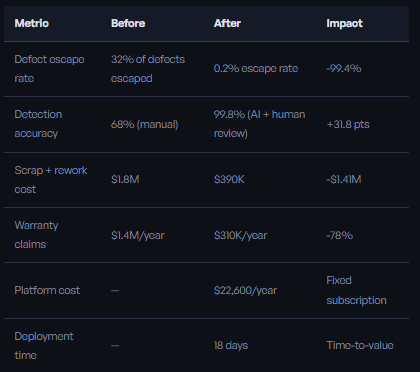
Those results are from a large plant, but the ROI logic scales to SMB environments because the cost drivers are universal: defects you ship are much more expensive than defects you catch early. The specific reported outcomes above come from an Oxmaint case study published March 21, 2026 (Oxmaint).
You should not assume you will replicate a vendor’s headline numbers. But you should use them as boundary conditions when you build your own business case:
If your defect escape is currently 2–5%, you may not see “32% → 0.2%” style swings. But you might still cut escapes by 30–70% in the first 90 days by focusing on the highest-frequency defect modes.
If your plant already has strong automation, your main win might be inspection speed (e.g., in-line rather than offline inspection), which frees operators to do higher-value work.
If you are regulated (medical devices, aerospace, food), the largest win can be traceability: storing inspection evidence per unit and making audits easier.
Separately, for manufacturers deploying AI-based industrial reliability solutions, an independent Forrester Total Economic Impact study reported 310% ROI over three years with payback in under 6 months (Augury). That is a different use case (maintenance, not vision), but it is helpful as a sanity check: industrial AI projects can achieve fast payback when they attack measurable loss categories.
Where SMB Manufacturers Should Start: 6 Inspection Targets With Fast Payback
If you try to “AI everything,” you will fail. Start where visual defects are frequent, expensive, and hard to catch consistently. Here are six high-ROI starting points that work across many SMB plants.
1) Labeling and packaging verification (high volume, low controversy)
These are the easiest wins: verify label presence, readability (OCR), correct SKU, correct lot/date codes, and tamper seals. The models are simpler, data collection is straightforward, and operators usually trust the outcomes quickly because the errors are obvious.
2) Assembly presence/absence and orientation checks
Think: missing fasteners, wrong gasket orientation, clip not seated, connector not fully engaged. The ROI here often shows up as fewer returns and fewer “mystery failures” in the field.
3) Surface defects (scratches, dents, porosity, weld quality)
This is the classic computer vision domain. Traditional rule-based vision struggles when defect appearance varies, lighting changes, or materials are reflective. Modern deep learning handles variability better by learning patterns rather than relying on hand-tuned thresholds.
4) Dimensional and geometric checks (with structured light or multi-view setups)
Many SMB plants assume “vision can’t do metrology.” That’s not always true. With the right setup (camera geometry, calibration, sometimes structured lighting), you can automate checks that previously required manual gauges or CMM sampling. You won’t replace your metrology lab, but you can catch gross issues earlier.
5) Anomaly detection for “unknown unknowns”
Anomaly detection (“learn what good looks like”) is useful when defect types are hard to enumerate. You train a model on good parts and flag outliers for human review. This is often the best approach for SMB lines with limited defect history data.
6) Final QA evidence capture for traceability
Even when the goal is not automated rejection, AI can capture standardized inspection evidence. That lowers audit friction and helps with customer quality complaints (“what did the part look like at ship time?”).
What It Costs in 2026: A Practical Pricing Map
Manufacturing AI spending usually fails for one of two reasons: (1) the software is priced like an enterprise suite and you only needed one workflow, or (2) the pilot works but scaling costs surprise you.
Below is a practical pricing map for SMB manufacturers in 2026. Consider these ranges as planning anchors, not quotes.
1) Workflow/operations platforms (build apps around inspection)
Some SMB manufacturers don’t need a standalone “vision AI product.” They need a way to build digital work instructions, capture inspection results, connect to devices, and run automations. Platforms like Tulip sell per “interface” (a device running apps). As of Tulip’s published plans, pricing starts at $100/month per interface (Essentials) or $250/month per interface (Professional), billed annually, with a 10-interface minimum (Tulip). That implies a planning baseline of roughly $12,000/year (Essentials) to $30,000/year (Professional) before add-ons.
Use this model if your bigger goal is operational digitization and you want inspection as one component. It pairs well with off-the-shelf cameras and a light-weight model service.
2) Industrial AI stacks (run and support models on-prem or in cloud)
If you want a supported AI software stack for edge inference (or to standardize GPU licensing), enterprise licensing can be priced per GPU. NVIDIA’s AI Enterprise list pricing (self-managed systems) is published as $4,500 per GPU for a 1-year subscription, $13,500 per GPU for 3 years, and $18,000 per GPU for 4 years (with “5 years for the price of four”) (NVIDIA). They also list a production pay-as-you-go rate of $1/hour/GPU plus cloud instance costs (NVIDIA).
For SMB, the point is not “buy NVIDIA AI Enterprise.” The point is: plan your costs around how many GPUs you need and whether you want support and lifecycle management.
3) The hidden costs: lighting, fixturing, and data labeling
The camera is often not the expensive part. Lighting and fixturing are. Bad lighting makes every model look dumb.
Lighting + mounts + enclosures: plan $500–$5,000 per station depending on environment and robustness.
Edge compute: plan $1,500–$8,000 for a compact edge box depending on GPU/CPU needs.
Labeling: plan 10–40 hours for your first defect mode (faster if you do anomaly detection first).
A simple SMB rollout might include 2 inspection stations plus 1 edge box plus software subscriptions. A reasonable “first 90 days” all-in budget for many SMB plants is $15k–$60k depending on whether you already have good cameras, your compliance needs, and how much integration you want.
How to Estimate ROI Before You Deploy Anything
Quality ROI math gets messy because defects create second-order costs. Here is a simplified framework that is good enough to decide whether to move forward.
Step 1: Define your “cost of a defect escape”
Pick your top product family and estimate:
Direct cost: warranty replacement, return freight, rework labor, scrap.
Indirect cost: customer downtime penalties, chargebacks, lost future orders.
Operational cost: time spent on RMAs, complaint investigations, extra inspections.
For many SMB manufacturers, a single field failure can cost anywhere from $50 (simple consumer item) to $5,000+ (industrial component with downtime). You do not need perfect precision; you need a defensible range.
Step 2: Measure current defect escape rate on a target defect mode
Don’t start with “all defects.” Start with one defect mode that has a clear visual signature and causes high costs. Calculate:
Units shipped per month
Estimated defect rate for that mode
Estimated percentage of those defects that escape current inspection
Step 3: Model three scenarios (conservative / expected / aggressive)
Example template:
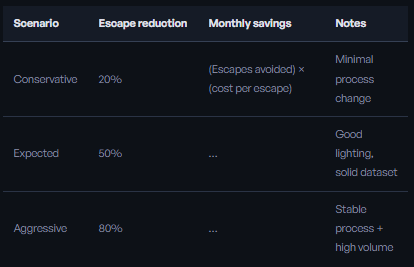
Then compare to your monthly cost (software + amortized hardware + labor). If your expected scenario produces a payback under 12 months, the project is usually worth doing. Many plants see payback in 3–9 months when they pick the right first station.
Continue reading FREE on ai.advalorem.io, includes:
Implementation Architecture That Works for SMB Plants
A 90-Day Rollout Plan (Designed for SMB Constraints)
Common Failure Modes (And How SMB Manufacturers Avoid Them)
The “SMB Advantage” in Vision AI
Sources
Oxmaint, “AI Vision Inspection Eliminates Defects and Prevents $8M in Recalls” (Mar 21, 2026): https://oxmaint.com/industries/manufacturing-plant/ai-vision-inspection-defect-detection-quality-case-study
Augury, “Augury’s Solutions Delivered 310% 3-Year Return…” (Sept 10, 2025 / published Oct 20, 2025): https://www.augury.com/media-center/press/augurys-solutions-delivered-310-3-year-return-according-to-independent-research/
NVIDIA, “Pricing — NVIDIA Enterprise Licensing Guide” (Mar 2, 2026): https://docs.nvidia.com/ai-enterprise/planning-resource/licensing-guide/latest/pricing.html
Tulip, “Plans & Pricing” (accessed 2026): https://tulip.co/plans/