
AI for Customer Support & Helpdesk Automation: Ticket Deflection, Agent Assist, and QA for SMBs in 2026

How small support teams use AI agents to resolve repetitive tickets, speed up human replies, and tighten QA—without breaking trust or compliance.
Support is where SMBs feel AI immediately: fewer repetitive tickets, faster human replies, and better consistency. The trap is thinking “buy an AI bot” equals results. In practice, ROI is a function of (1) intent coverage, (2) knowledge quality, (3) escalation design, and (4) measurement discipline.

What’s different in 2026
AI agent pricing has normalized: many vendors now charge for outcomes/resolutions plus a base platform plan.
Deflection is no longer the only win: agent assist and QA automation often outperform deflection in complex B2B support.
Guardrails matter more than model choice: good teams ship with strict scopes, citations to KB content, and clear handoff triggers.
The 3 workflows that pay back fastest
1) Ticket deflection (AI resolves without a human)
Best for: order status, password resets, basic billing, policy questions, repeat troubleshooting steps.
Prerequisites: 30–80 high-quality KB articles mapped to top intents; escalation rules for edge cases.
Success metric: containment/deflection rate + re-open rate (bad deflection shows up as re-opens).
2) Agent assist (draft replies, summarize threads, suggest macros)
Best for: B2B support, complex troubleshooting, account-specific issues.
Success metric: median handle time and first-response time.
3) QA + knowledge improvement loop (AI audits conversations)
Best for: small teams that need consistent policy enforcement and faster onboarding.
Success metric: fewer escalations, fewer refunds/credits due to policy errors, faster new-agent ramp.
Vendor landscape (SMB-friendly)
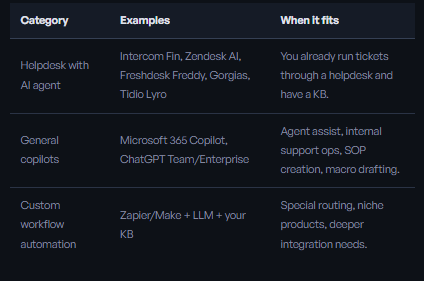
Pricing snapshot (usable for budgeting)
Intercom Fin: published outcome pricing of $0.99 per outcome (e.g., resolution), charged once per conversation. (https://www.intercom.com/help/en/articles/8205718-fin-ai-agent-outcomes)
Intercom Essential plan: listed from $29 per seat/month with Fin included, with outcome charges on top. (https://www.intercom.com/pricing)
Microsoft 365 Copilot: Copilot Chat is listed as included for eligible Microsoft 365 subscriptions; using agents requires an Azure subscription. (https://www.microsoft.com/en-us/microsoft-365-copilot/pricing)
Case study signal (what good performance looks like)
Tidio’s support team: reports 58% automation with Lyro in a published case study. (https://www.tidio.com/blog/lyro-case-study/)
ROI model (plug in your numbers)
This is the simplest model that prevents bad purchases: don’t start with “AI will save time.” Start with ticket economics.
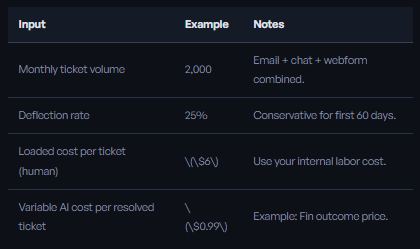
Tickets deflected: \(2,000 \times 25\% = 500\)
Labor avoided: \(500 \times \$6 = \$3,000\)
AI variable cost: \(500 \times \$0.99 = \$495\) (plus platform seats)
Net variable savings: \(\$3,000 - \$495 = \$2,505\)/month
If you can’t break even on variable cost in your first 60–90 days, your KB and routing need work before you scale.
90-day rollout plan (SMB version)
Days 1–14: Prepare the knowledge + routing
Cluster the last 500–2,000 tickets into the top 25–50 intents.
Write/repair 1 KB article per intent. Keep them short, with screenshots and step-by-step.
Define handoff triggers: refunds, legal threats, PII edits, account cancellation, “angry customer”.
Instrument logging: unknown intent rate, handoff reasons, hallucination flags.
Days 15–45: Launch deflection for the safest 10–15 intents
Roll out to a subset of channels first (web chat before email).
Enable human review mode for week 1 if your platform supports it.
Measure daily: deflection, re-open, CSAT for deflected tickets, and top failure intents.
Days 46–90: Add agent assist + QA automation
Deploy AI summaries and draft replies for human-handled tickets.
Automate QA checks (5–10): tone, policy compliance, missing troubleshooting steps, refund policy.
Set a weekly KB improvement cadence based on unresolved intents and QA findings.
Common failure modes (and how to avoid them)
Garbage knowledge: AI will mirror it. Fix the KB first.
Overbroad scope: keep early rollout limited to safe intents.
No measurement loop: you need dashboards for deflection, re-opens, and unknown intents.
Security gaps: confirm data retention, redaction, and permissions for support transcripts.
What to do next
If you want a strategy-grade implementation plan, the highest leverage step is an intent audit: pull ticket data, rank top intents, map knowledge coverage, and design escalation rules and success metrics. That’s the blueprint that makes any vendor work.
Sources
Intercom — Fin AI Agent outcomes (pricing): https://www.intercom.com/help/en/articles/8205718-fin-ai-agent-outcomes
Intercom — pricing: https://www.intercom.com/pricing
Microsoft — Microsoft 365 Copilot pricing: https://www.microsoft.com/en-us/microsoft-365-copilot/pricing
Tidio — Lyro case study: https://www.tidio.com/blog/lyro-case-study/