
AI Direct Ordering, Labor Forecasting, and Guest Messaging for SMB Restaurants in 2026

Third-party delivery platforms can take 15–30% per order, while AI agents now handle phones, texts, and personalized offers 24/7. This report shows how a 1–5 location restaurant can use AI to shift demand to direct ordering, improve labor scheduling accuracy, and protect margins—with concrete pricing benchmarks and a 90-day rollout plan.
For independent restaurants, 2026 is the year the “AI promise” becomes operational reality. Not because robots are flipping burgers (some are), but because the highest-leverage work in a 1–5 location business is communication and coordination: answering phones, capturing orders, managing reservations and waitlists, reacting to demand swings, and bringing guests back without discounting your margins away.

Two forces are colliding:
Marketplace dependency (third‑party delivery and listing apps) is expensive and structurally misaligned with operator profitability.
Generative + agentic AI is now good enough to run narrow workflows end-to-end: take an order, modify it, handle an allergy question, follow up, recover a dissatisfied guest, and schedule tomorrow’s prep team based on forecasted covers.
McKinsey frames the shift simply: “Automation and gen AI could improve restaurant margins and productivity, while also lowering innovation costs,” and “AI-enabled personalization is beginning to deliver dramatically higher conversion.” (McKinsey) That is exactly the playbook for SMB restaurants: use AI to protect margins by shifting more demand to owned channels, while using forecasting and automation to make labor more efficient at the same time.
The Core Thesis: Treat Delivery Marketplaces as Lead Gen (Not a Business Model)
If you run a restaurant, you already understand the unit economics: food cost, labor, occupancy, and a handful of controllable operating expenses. Third‑party delivery platforms add a new variable: the platform tax. The value proposition is demand. The hidden cost is that the platform owns the customer relationship and charges you for access to your own buyers.
This is why “direct ordering” has become the strategic center of gravity for SMB operators. Not because you want to abandon delivery, but because you want a higher percentage of orders flowing through a channel where you keep the economics and the data.
Here is what “direct” means in practice:
A branded ordering site or app (web is fine) integrated to your POS.
A guest database (email + SMS + behavior) with consent.
An automation layer that triggers personalized outreach based on signals (lapsed guest, high-value guest, rainy day, slow Tuesday, etc.).
An AI “front desk” for voice + text so you do not lose orders when you are slammed.
In 2026, the biggest change is that the automation layer is no longer “if this then that.” It is conversational, multi-step, and tolerant of messy real life.
A Practical 2026 Stack (1–5 Locations)
Restaurants often over-complicate tech decisions. You do not need 20 tools. You need 5 capabilities that work together:
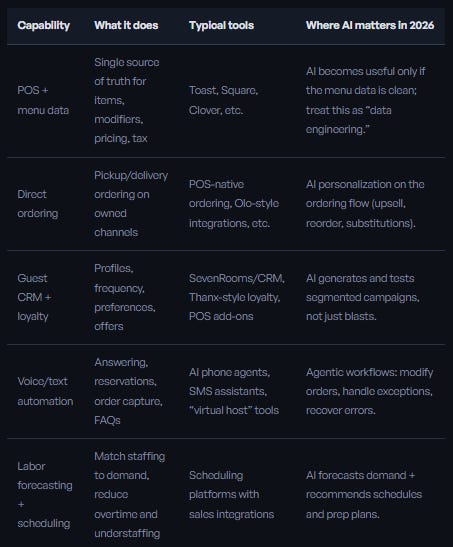
The sequencing matters: start with direct ordering + AI front desk (revenue capture), then add loyalty/CRM (retention), then tighten labor forecasting (margin). Doing labor first often fails because the “extra margin” is not visible quickly enough to maintain momentum.
Pricing Benchmarks You Can Actually Use
Restaurant tech pricing is notoriously opaque. Still, you can anchor your budget using a mix of posted pricing, public FAQs, and reputable third‑party plan breakdowns.
1) Delivery marketplace cost signals (and why you need a direct channel)
Even if you never look at a settlement statement, you can see how platforms monetize the relationship: commissions + optional products + operational tooling. DoorDash’s merchant FAQ makes one small but revealing detail explicit: if you accept orders on a DoorDash tablet, the hardware rental is free during your trial and then costs $6/week in the US. (DoorDash for Merchants FAQ) It also notes there are no hidden fees like activation or cancellation fees, but that after the trial you are enrolled in the commission and tablet fees shown on your signup sheet. (DoorDash for Merchants FAQ)
Why does a $6/week tablet matter? Because it is the visible part of the model. The invisible part is margin leakage through commissions, promotions, and customer ownership. If you want to run profitable delivery, you need a conversion engine: turn marketplace customers into direct customers over time.
2) POS baseline (as a reference point)
Most SMB operators already pay for POS. What matters is understanding the delta cost of “AI-enabling” your stack: online ordering modules, integrations, and labor tools. Third‑party analyses of Toast pricing, for example, commonly describe a $69/month baseline for core POS software (first terminal) with payment processing fees layered on top, plus optional add-ons for online ordering and other modules. (CheckThat.ai (Toast pricing analysis)) Treat any vendor-specific numbers as directional unless you have a quote; the goal is to budget for categories of spend.
3) Labor scheduling (per-location economics)
Labor tools are one of the simplest “AI margin” wins because they scale per location and do not require changing your menu or guest experience. Public plan breakdowns for scheduling products often start with low-cost per-location tiers, with higher tiers including forecasting and integrations. For example, third‑party pricing breakdowns for 7shifts describe entry tiers around $44.99 CAD/location/month and tiers with forecasting around $84.99 CAD/location/month. (CheckThat.ai (7shifts pricing analysis))
4) Marketing automation and “AI monthly plans”
Marketing platforms increasingly sell “AI” as packaged output: a generated monthly plan, campaign assets, and suggested promotions. Popmenu positions an “AI Marketplace” that creates a marketing strategy and content unique to a restaurant (emails, texts, and social posts) with an approve-and-send workflow. (Popmenu AI Marketplace)
Pricing varies heavily by operator size and add-ons. One public pricing breakdown describes Popmenu plans starting at $179/month and describes add-ons such as online ordering and AI-related features priced separately. (Restolabs (Popmenu pricing analysis)) Use this as a budgeting proxy: in SMB, “AI marketing” usually lands in the $200–$800/location/month range when you bundle website + messaging + ordering + content tools.
The ROI Model: Where SMB Restaurants Actually Get Payback
There are three ROI levers that matter for a small operator:
Revenue capture — stop missing calls, convert more web traffic, improve order accuracy.
Channel mix shift — move a portion of delivery demand from marketplaces to direct ordering.
Labor efficiency — reduce overtime and overstaffing while protecting service quality.
The mistake many operators make is trying to measure “AI ROI” as a single number. Instead, treat each lever as a separate initiative with its own measurement, then roll them up into a single margin impact.
Lever 1: Revenue capture (the phone is still your highest-converting channel)
When the dining room is full, phones become a tax on your staff. Humans pick up less often, they rush, and they make mistakes. AI voice agents flip that: they answer every call, handle common questions, and can capture orders or reservations with structured data. In practice, the immediate win is not “AI quality”; it is availability.
How to quantify it:
Baseline: missed call rate during peak hours (you can sample one week).
Estimate: incremental orders captured × average ticket × gross margin.
Secondary: fewer comps and remakes due to misheard modifications.
Lever 2: Channel mix shift (convert marketplace orders into direct)
The most profitable delivery order is the second one. The first one often comes through a marketplace because that is where discovery happens. Your job is to convert that guest to a direct relationship:
Insert a direct-order insert or QR code with every delivery (legal and platform-policy compliant).
Offer a “direct perks” benefit: free side, priority pickup window, or loyalty points—avoid headline discounts if possible.
Use SMS/email to follow up with a reorder reminder timed to the guest’s behavior.
Use personalization (favorite items, dietary preferences, time-of-day behavior) to increase conversion without increasing discounting.
McKinsey’s point that AI-enabled personalization can drive “dramatically higher conversion” matters because it reduces your need to rely on blanket discounts. (McKinsey)
A simple financial model you can run in a spreadsheet:
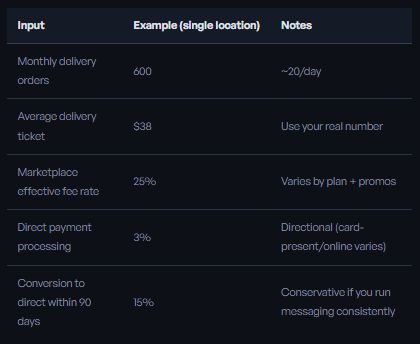
If you convert 15% of 600 monthly delivery orders (90 orders) from 25% marketplace fees to 3% processing, you shift ~22 percentage points of the ticket back into your business. On $38 tickets, that is roughly $7–$8 per order in recovered margin, or ~$630–$720/month. That alone can fund your CRM + messaging + AI front desk stack for a single location.
Lever 3: Labor efficiency (forecasting is the quiet margin engine)
Labor is your largest controllable cost. The reason forecasting tools matter is that they turn historical sales into staffing recommendations and reduce last-minute scramble. The “AI” is not magic; it is simply better utilization of the data you already have.
Where forecasting saves money:
Overstaffing on slow days (especially weather-driven demand drops).
Understaffing that causes service failures (and therefore comps + bad reviews).
Overtime from poor schedule design.
Manager time spent building schedules and handling shift swaps.
Operators often ignore manager time as “free.” It is not. In a small business, manager attention is the scarcest resource you have.
Continue reading FREE on ai.advalorem.io, includes:
Implementation Architecture: Data Flow That Actually Works
A 90-Day Rollout Plan (Designed for Small Teams)
Risk, Compliance, and Brand: The Non-Negotiables
What to Do This Week (If You Want the Fastest Payback)
Sources: McKinsey — Future of restaurants: Redefining dining out (2026) | DoorDash for Merchants FAQ | Popmenu — AI Marketplace | Restolabs — Popmenu pricing (2026) | CheckThat.ai — 7shifts pricing analysis (2026) | CheckThat.ai — Toast pricing analysis (2026)